
For care homes
Everything a medication round needs, and the record to prove it happened.
From the barcode at the bedside to the audit trail in the office. Built around the questions an inspector actually asks: who gave it, when, was it right, and what did you do when it was not.
Plans from £34.99 a month · ten residents included · care home log in
The round
Built for the corridor, not the desk.
A carer has one hand free and a trolley to push. The record has to be finishable at the bedside or it gets written up later from memory — which is exactly where paper charts fail.
Scan the pack
The app opens on the residents still to see, anyone with medicines due first. Open a resident and you get the doses due now — not a month grid to hunt through for today's column.
One outcome per dose
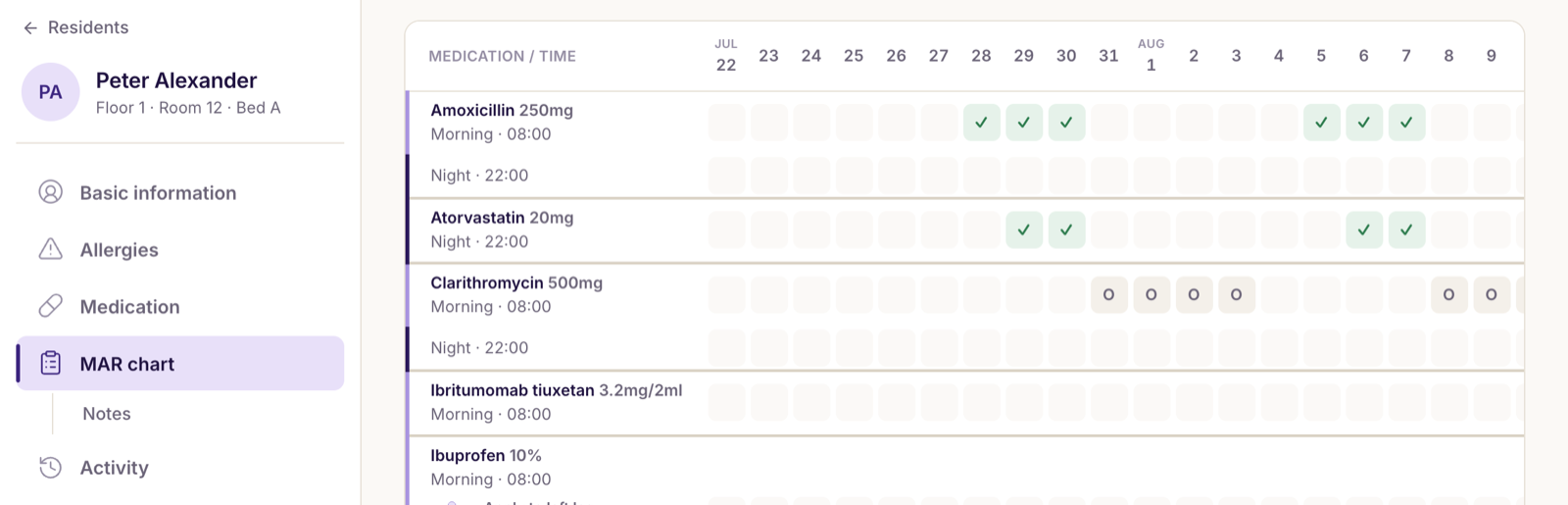
Scanning the pack is the route to given, and the server re-checks the barcode. Everything else is a reason code, printed on the chart as its letter. A controlled drug asks for a second signature there and then.
Signed at the bedside
Stock going back is dealt with at the trolley, a care note is written while the carer still remembers how it went, and the next resident is named. Nobody has to go back and finish anything.
Five states
Five states a carer can learn once and trust everywhere.
Every state carries a colour, a word and a mark. Remove any one of the three and the row still reads — on a cracked screen, in sunlight, in a photocopied chart, and for the roughly one in twelve men with a colour vision deficiency.
Administered and signed for, against a barcode that matched, with the time it happened.
Scheduled for this round and not yet recorded. Still inside its window.
Declined by the resident, with a reason recorded against it. A finished piece of work.
Its time has been and gone with no outcome recorded. The board shows it first.
A PRN not needed, or not one of this medicine's days. Nothing outstanding.
No brand colour ever signals a clinical state. Mint means eMAR — it never means “given”.
What we do for you
Everything the home runs on, in one login.
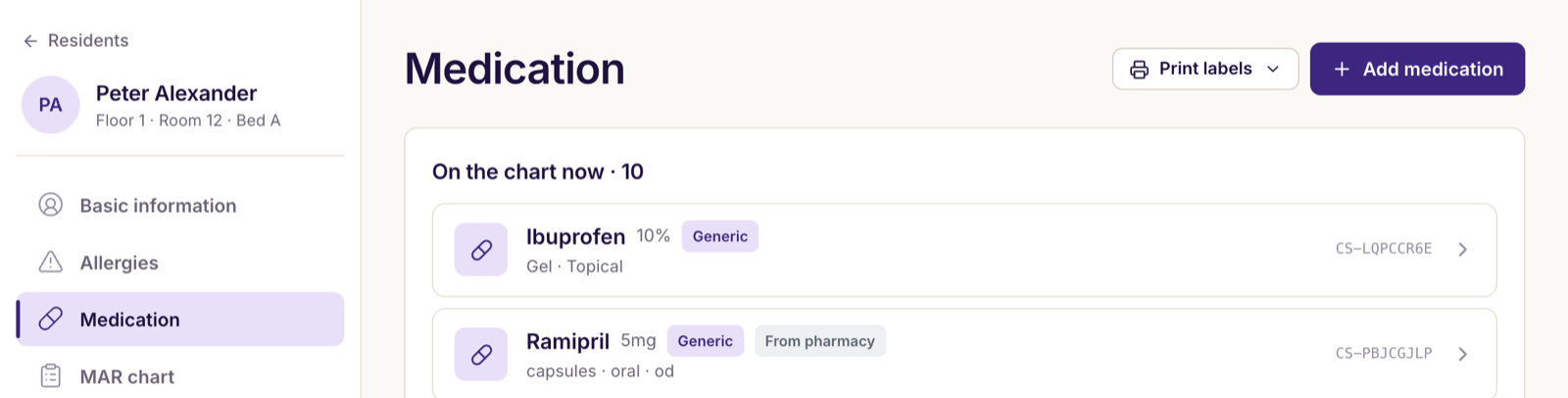
Residents, medications, the MAR chart and printing come with every plan. What each plan adds is on the pricing page.
eMAR & scan to give
Barcode-verified administration with every MAR code, PRN protocols with a recorded reason, and controlled drugs countersigned by a second member of staff at the trolley.
MAR chart
Generated from what was recorded at the bedside, laid out across your pharmacy's supply cycle. On screen and printed.
Residents & your building
Floors, areas, rooms and beds with live occupancy. A resident is admitted to a real bed, so two people can never hold the same one.
Vital signs
Observations on a schedule — blood pressure, pulse, temperature, oxygen, weight, blood glucose — prompted before the round rather than after it.
Wound tracker & body maps
Every wound on a body map, with type, origin, pressure-ulcer category, measurements, tissue and exudate, photographed and reviewed over time.
Resident movements
Admissions, hospital transfers, leave and returns as dated events — the ADT trail behind a digital social care record.
Care notes
The daily record written at the bedside in the staff app, with concerns flagged to the nurse or manager the same day.
Resident feedback
The monthly conversation with every resident, compliments and complaints captured as raised, and a list of who has not been asked.
Roster & shift templates
Build the week on a grid, copy templates from one week to the next, and assign staff to floors and areas.
Timesheets
Clock in and out from the staff app on the floor. Worked hours come from attendance, not from a spreadsheet.
Staff, roles & permissions
Carers, nurses, inventory and admin roles, each with its own access. Every entry on the record carries the name of who made it.
Deliveries & returns
Incoming deliveries received against what was dispensed, and stock going back to the pharmacy tracked as its own pipeline.
Controlled drugs register
CD schedules, witnessed countersignatures on every outcome including refusals and destruction, and a running register.
Reports & exports
Medication, stock, deliveries and controlled drugs — the reports you are asked for, exportable.
Activity log
Every action across the organisation, timestamped and attributed. Answers “who changed this, and when”.
Notifications
Low stock, an unacknowledged concern, a resident overdue back from hospital — raised to the people who can act on it.
Security
Two-factor authentication, witness PINs, role-based access and per-organisation isolation.
Billing & plans
Change plan, buy resident capacity and switch modules on or off from your own billing screen. Invoices update the same day.
Evidence, not paperwork
What it helps you show an inspector.
Keeping these records helps you show what your service did. It supports an inspection; it does not replace your own policies, judgement or governance.
- Regulation 17 — an accurate, complete and contemporaneous record for each person, with a name and a time on every entry
- Regulation 12 — the safe management of medicines, with the scan and the second signature enforced rather than assumed
- Regulation 9 — daily notes as the running evidence of what changed and what you did about it
- Regulation 16 — complaints captured when they are raised, not when they escalate
Bring your pharmacy with you
Link to whichever pharmacy supplies you with an invite code, and medication they dispense lands on your residents' charts without a phone call. Your pharmacy may also fund your subscription — plenty do.
Questions
Care home questions.
Which plan do we need?
Standard covers residents, medications and the MAR chart. Pro adds the staff app, barcode scan and give, the roster and timesheets. Advanced adds reports, the full activity log and security controls. You can change plan from your billing screen at any time.
Does this replace our paper MAR charts?
Yes. The MAR chart is generated from what staff actually record at the bedside, so it is contemporaneous by construction rather than written up afterwards. You can still print it.
What if a resident goes into hospital?
Record the movement and their status changes with it. Nothing can be signed for a resident who is not in the building — the round hides their doses and the server refuses them, so a stale phone cannot record a dose against someone on a ward.
Can staff give medication without scanning?
A dose can only be marked as given against a scan that matches that exact medicine. Every other outcome — refused, asleep, in hospital — is recorded with a reason code and no scan, which is how a real round works.
How do controlled drugs work?
Every controlled drug needs a second member of staff to countersign with their own PIN, at the trolley, on any outcome — including a refusal or a destruction, which is exactly what an inspector looks hardest at.
Do we have to buy every module?
No. Movements, care notes and resident feedback are add-ons you switch on when you want them, from £2 a month. The eMAR, residents, MAR chart and audit trail come with every plan.
Who pays — us or our pharmacy?
Either. Many pharmacies fund the eMAR for the homes they supply. Equally you can register yourself, choose your own plan, and link to your pharmacy with an invite code — your account and your data stay yours.